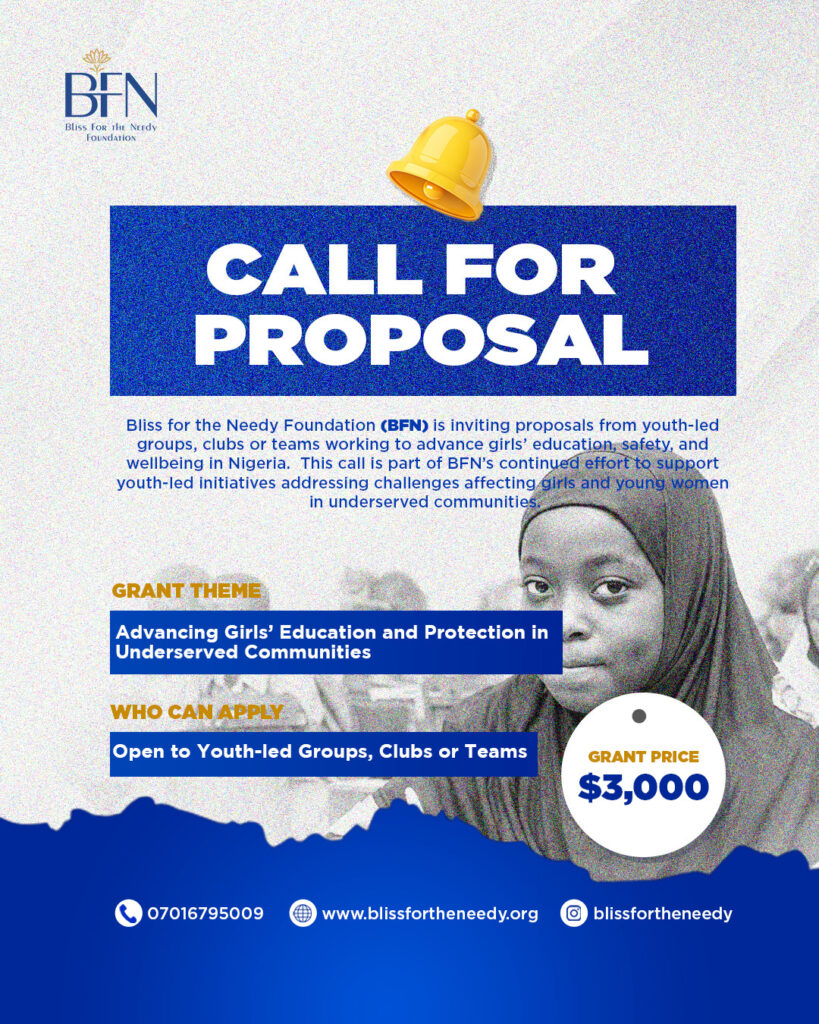

Bliss for the Needy Foundation (BFN) is inviting proposals from youth-led groups, clubs or teams working to advance girls’ education, safety, and wellbeing in Nigeria. This call is part of BFN’s continued effort to support youth-led initiatives addressing challenges affecting girls and young women in underserved communities.
Proposed projects should go beyond short-term interventions by demonstrating the potential to influence policy development, contribute to systemic change, or develop approaches that can be replicated or adapted in other communities.
Grant Theme
Advancing Girls’ Education and Protection in Underserved Communities
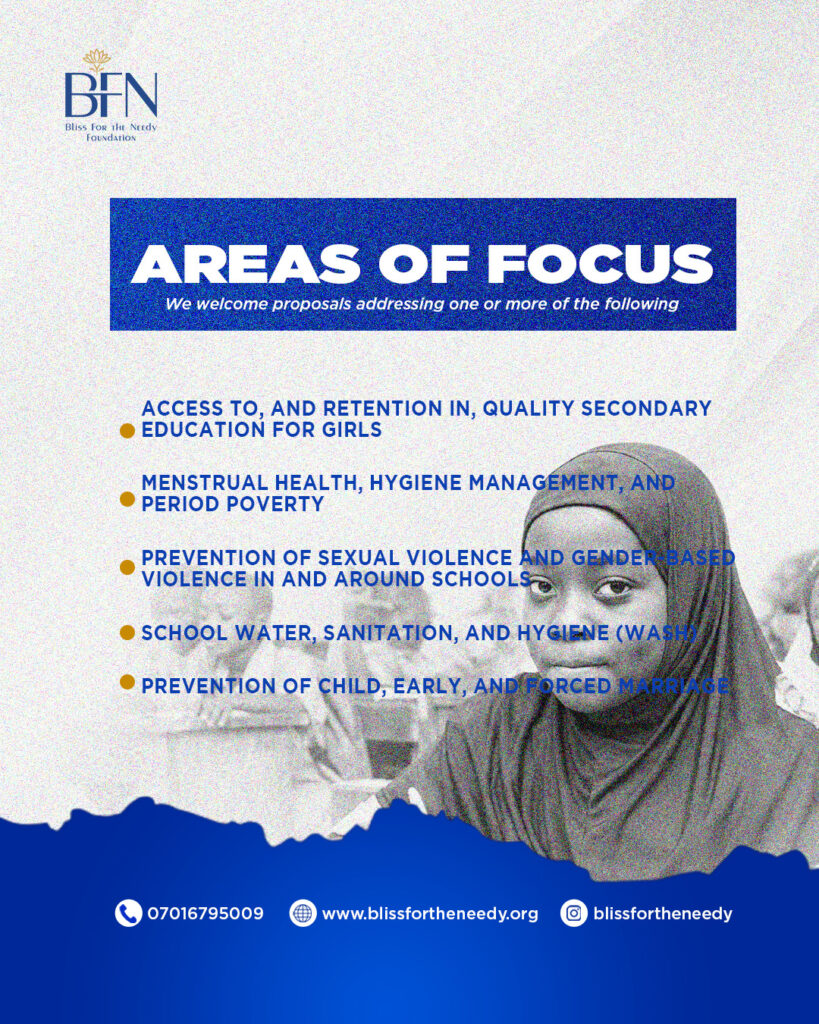
Areas of Focus
We welcome proposals addressing one or more of the following:
- Access to, and retention in, quality secondary education for girls
- Menstrual health, hygiene management, and period poverty
- Prevention of sexual violence and gender-based violence in and around schools
- School water, sanitation, and hygiene (WASH)
- Prevention of child, early, and forced marriage
Locations
Priority will be given to projects sited in Kaduna, Borno, Bauchi, Oyo, and Adamawa States. Proposals should demonstrate a clear understanding of the needs of girls and young women in the proposed project location and show how the proposed intervention can contribute to lasting change within the community or wider system.
Grant Size
A grant pool of $3,000 will be used to support proposals selected through this call. Applicants should design realistic, right-sized budgets, as grant awards will reflect the strength of the proposal, the scale of the intervention, and the number of projects selected for funding.
Who Can Apply
This call is open to BFN member youth-led groups, clubs or teams.
Applicants must:
1. Be youth-led, with young people actively involved in the leadership, planning, decision-making, and implementation of the proposed project.
2. Be members of Bliss for the Needy Foundation (BFN).
3. Have a demonstrated connection to, or presence within, one of the priority locations listed above. Newly formed teams should demonstrate a clear connection to the proposed project community.
4. Propose a project that addresses at least one of the identified areas of focus and has the potential to contribute to long-term and systemic change, rather than providing only a one-time or short-term intervention.
5. Demonstrate how the project will engage with, inform, influence, or contribute to policy development, institutional practices, community systems, or decision-making processes relevant to the issue being addressed.
6. Present a replicable or adaptable model that can potentially be implemented in other communities, schools, LGAs, or states facing similar challenges.
7. Clearly identify the change the project seeks to achieve, the systems or stakeholders it intends to influence, and how the proposed approach can be sustained beyond the grant period.
Click the link to apply https://forms.gle/Qooj3A9YtXrHxsvC9